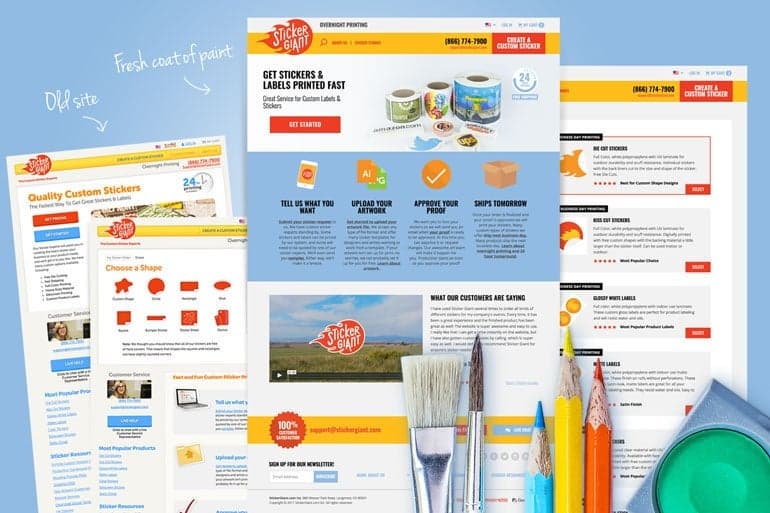
How Data Drove the StickerGiant Website Redesign
See how StickerGiant used real user data, usability testing, and conversion metrics to guide a full website redesign that improved mobile UX and shopping performance.
StickerGiant, a custom sticker and label company in Colorado, redesigned its website with one clear objective: use data to improve the customer experience. Every decision—from navigation structure to page speed—was validated through testing, analytics, and real user behavior. This article breaks down how we approached the redesign, what we measured, and what other ecommerce teams can learn from a data-first process.
Why We Redesigned the Site: Answer First
We redesigned StickerGiant.com to improve clarity, reduce distractions, and increase conversions across mobile and desktop. The redesign was not based on guesswork. Every change had to outperform the previous version in speed, click-through rates, and ease of use.
What Prompted the Redesign?
How Do You Improve an Already High-Performing Ecommerce Site?
You measure everything. At our Longmont headquarters, our Marketing Command Center displays real-time analytics that help us understand how customers move through the site. These insights established the foundation for our redesign strategy.
We approached the redesign with requirements:
No change would go live unless it met or exceeded the performance of the previous design
Speed improvements were mandatory
Click-through rates had to increase, especially for high-intent CTAs related to ordering Custom Stickers and Custom Labels
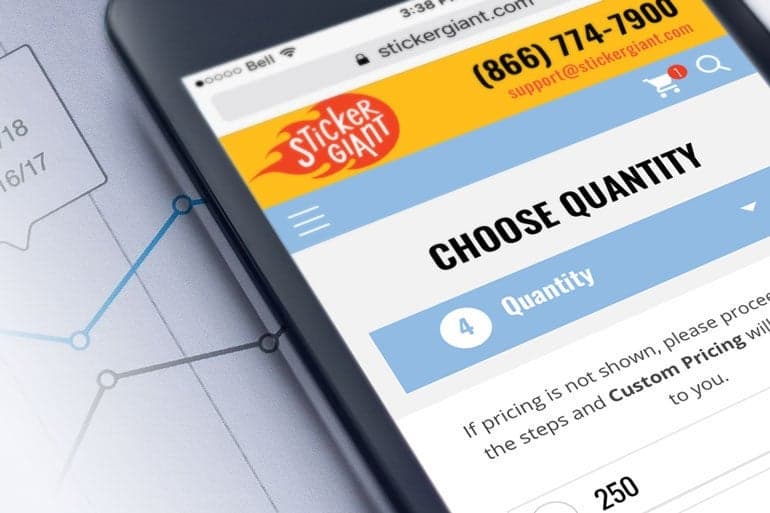
The redesigned experience needed to reduce cognitive load, especially on mobile
Analytics-driven decision-making has always been part of our culture. Each week, the entire company reviews a Scorecard with 15 key performance metrics. This keeps teams aligned and ensures website improvements support customer needs.
Usability Testing: What We Learned from 500+ Real Users
What Tasks Did We Ask Users to Perform?
We partnered with Bluespark to run six months of usability testing. More than 500 testers completed over 100 scenarios that mimicked real shopping questions such as:
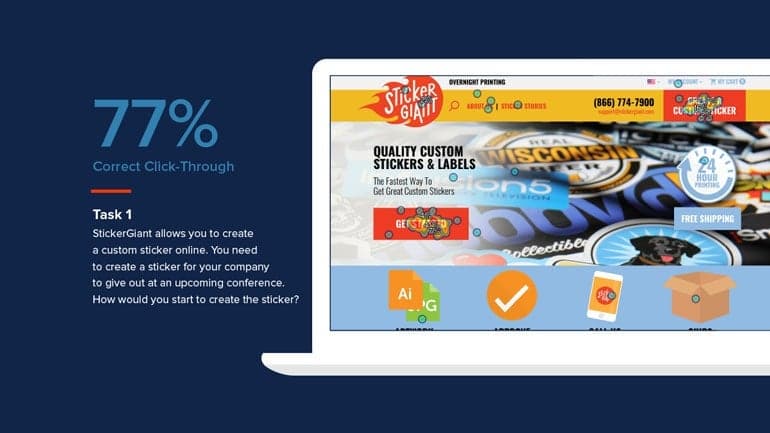
“How would you start creating a custom sticker for an upcoming conference?”
“Where would you click to order product labels for packaging?”
The goal was simple: identify friction and validate improved designs before release.
How Did Performance Change?
Using the previous homepage, only 63% of users clicked the correct starting point to create a custom sticker. With the new design, that number jumped to 77%.
A clear, measurable improvement meant the design was approved.
Reducing Distraction to Improve Conversions
Why Does Design Simplicity Matter in Ecommerce?
Even high-quality content can become noise if it competes with the primary action users want to take.
Before the redesign, long pages and excess links diluted focus. With the update, we:
Simplified calls-to-action
Reduced redundant content
Moved secondary information to an expandable footer
Streamlined mobile navigation
The objective: guide customers directly into creating custom stickers or ordering product labels with fewer competing choices.
Why Focus on Conversion Paths?
Because customers who get distracted abandon the process before uploading their artwork. The new design eliminates unnecessary steps, making it easier to move from idea to production.
Monitoring Live Data After Launch
What Happens After a Redesign Goes Live?
A successful launch is not the finish line. It’s the starting point for continuous optimization.
After deploying the new experience, our teams monitored:
Real-time click-through rates
Conversion rates across desktop and mobile
Interaction with educational content
Engagement on landing pages and support diagrams
Video completion rates
Performance of “create a custom sticker” call-to-action
Early results confirmed the upward trends seen during testing, validating both the design and the data methodology.
How We Continue Improving the Site
What Comes After Launch?
We entered what we call Phase 4—iterative refinement based on live behavior.
Planned improvements include:
Testing variations of the order flow
Adjusting design placements to reduce friction
Reviewing anonymous user recordings to understand hesitation points
Using weekly Scorecard insights to guide updates
Customers continue to influence every decision. If you ever have feedback about the site, our Customer Service Team is always available.
Key Takeaways
Data guided every step of the StickerGiant redesign
No design change launched without proving it improved performance
Usability testing revealed clearer paths for ordering custom stickers and product labels
Reducing distraction improved focus and conversion rates
Monitoring post-launch behavior ensures continuous optimization
Frequently Asked Questions
Why did StickerGiant redesign its website?
To improve clarity, speed, and conversion rates using a data-driven approach.
How did you measure improvements?
We compared new designs against baseline metrics including click-through rates, page speed, and user task success rates.
What is the biggest result of the redesign?
Users now reach key actions—like creating a custom sticker—faster and more successfully.
How do you test new design changes?
Through structured usability testing, analytics reviews, and real-time monitoring inside our Marketing Command Center.
Will the website continue to change?
Yes. We continuously optimize based on customer behavior, performance metrics, and new user needs.