

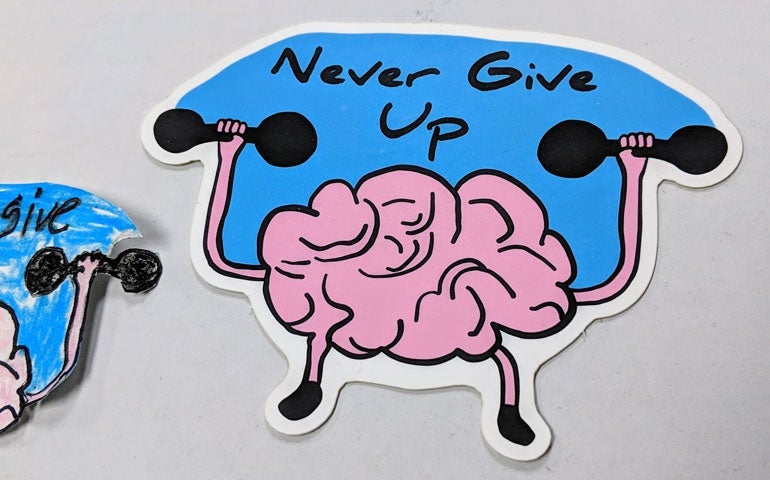
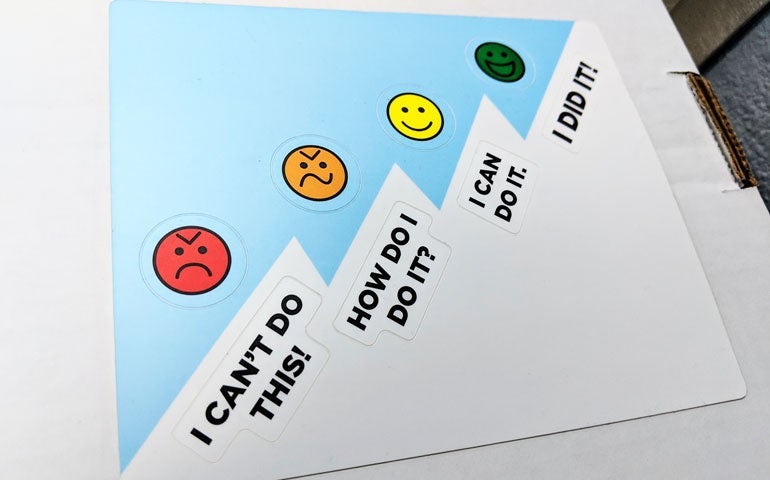
StickerGiant, a custom sticker and label company in Colorado, partnered with Mountain View Elementary to guide 4th Grade students through a real-world STEM design challenge. The goal was simple and inspiring: create a custom sticker that communicates the Growth Mindset philosophy. The result was a hands-on learning experience that connected classroom curiosity with professional design and production.
What Was the STEM Sticker Design Challenge?
The challenge asked each student to design a sticker that promotes Growth Mindset thinking. Students worked in teams and followed a structured design process used by professional creatives.
The Six Stages Students Followed
-
Empathy
-
Definition
-
Ideation
-
Prototyping
-
Testing
-
Finalizing
This step-by-step approach helped students learn how ideas evolve from concept to finished product.
How StickerGiant Supported the Students’ Creative Workflow
Introducing Students to Graphic Design
Alan Peters, founder of Jupiter Visual and a StickerGiant graphic designer, visited the 4th Grade classroom to talk about where strong design ideas come from and how designers solve problems visually.
Reviewing Student Prototypes
After initial sketches and prototypes, members of the StickerGiant team—including Customer Success, Marketing, Art, and Production—returned for classroom focus groups. Students presented their designs, gathered feedback, and refined their concepts.
Turning Student Art Into Print-Ready Stickers
StickerGiant hosted a formal judging panel led by CEO John Fischer. The two winning designs were passed to the Art Team, who converted hand-drawn illustrations into vector artwork. From there:
-
Press operators printed the stickers
-
The finishing team prepared the final products
-
Students saw their ideas become real, high-quality stickers they could hold and share
How the Project Strengthened Community Education
In December, StickerGiant returned to Mountain View Elementary to announce the winning designs at a school assembly. Students shared their process with the entire school, showing how STEM learning can combine creativity, teamwork, and problem-solving.
This project sparked a new educational partnership and demonstrated what happens when local businesses support hands-on learning.
Why STEM + Design Matters for Young Learners
STEM education often focuses on technical skills, but design-thinking adds important layers:
-
Visual communication
-
User-centered problem solving
-
Iteration and testing
-
Real-world application
For Mountain View Elementary, the sticker format created an accessible entry point—every student already loves stickers, and seeing their own design produced by a professional manufacturer was a powerful motivator.
Key Takeaways
-
StickerGiant partnered with Mountain View Elementary on a STEM design challenge promoting Growth Mindset.
-
Students followed a professional six-stage design process.
-
The StickerGiant Art, Production, and Leadership teams reviewed and produced two winning sticker designs.
-
The project strengthened community connections and showcased real-world STEM applications.
FAQ
Are the student-designed stickers produced like regular StickerGiant products?
Yes. The winning designs were converted into vector artwork and printed using the same high-quality production process used for all StickerGiant stickers.
What skills did students gain from the design challenge?
Students learned problem definition, visual communication, prototyping, testing, and iteration—core components of both STEM and design thinking.
Why were stickers chosen for the Growth Mindset project?
Stickers are familiar, fun, and highly shareable, making them an effective way for students to express ideas and see their work transformed into a tangible product.
How did StickerGiant teams participate?
The Art Team prepared production-ready files, the Production Team printed and finished the stickers, and members of leadership and customer-facing teams participated in review and judging.
Can other schools partner with StickerGiant for educational projects?
StickerGiant supports community initiatives when possible. Schools can reach out to explore opportunities.